
The New Era of RFID in the Supply Chain
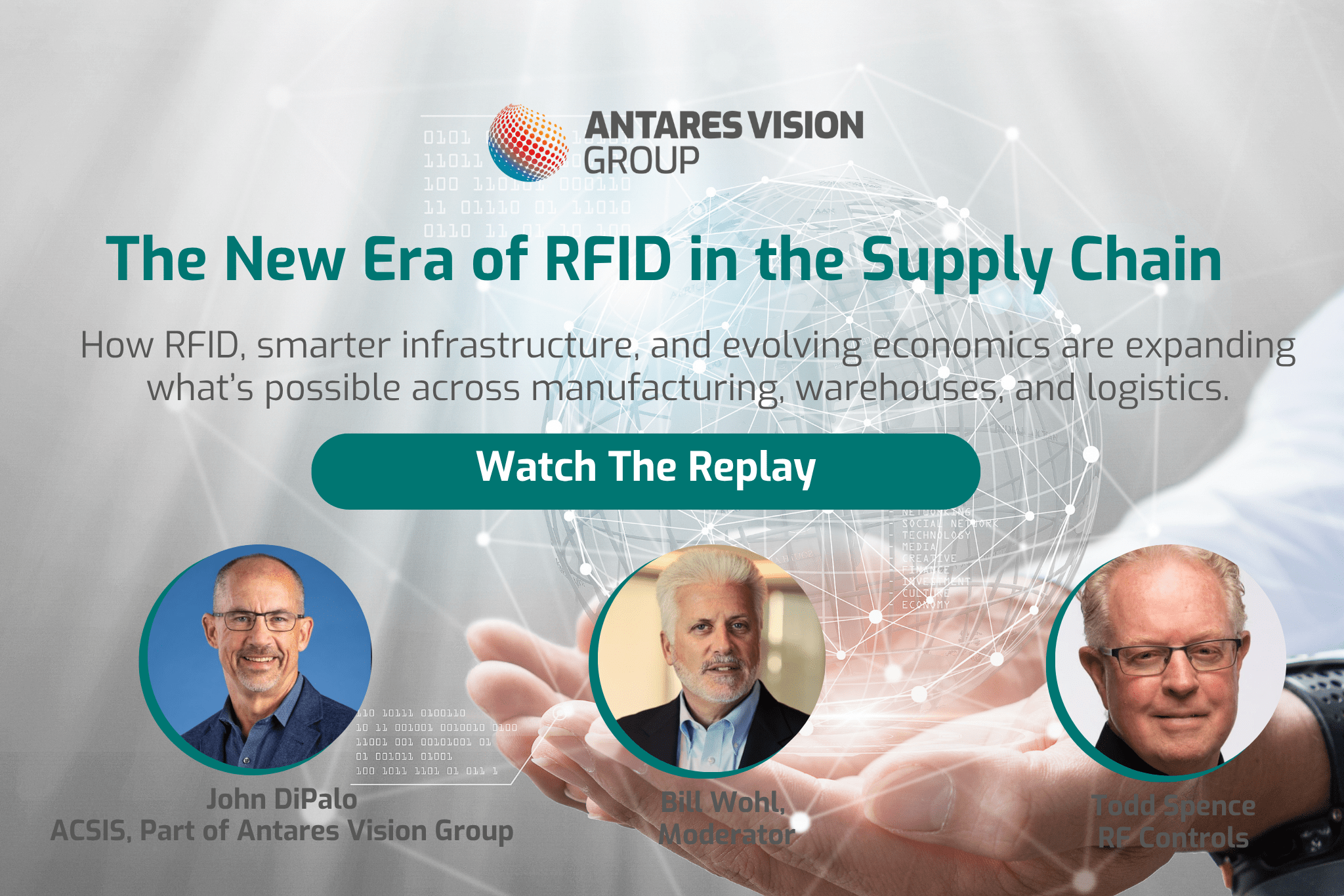
A LinkedIn Live Recap Featuring John DiPalo at ACSIS and Todd Spence at RF Controls
Hosted by Bill Wohl on April 28, 2026
Watch the Full LinkedIn Live Recording
If you missed our recent live session on LinkedIn, no worries. You can catch the full replay right here:
🎧 Listen to the full LinkedIn Live replay here
📄 View transcript included below
Key Takeaways from the Discussion
Supply chain visibility has reached a tipping point. With advances in overhead antenna technology, passive RFID is no longer just about compliance — it’s about transforming warehouse operations. In this session, ACSIS Chief Strategy Officer John DiPaolo and RF Controls Co-founder Todd Spence explained how steerable phased array antennas are changing the game for real-time location systems.
Here’s what we learned:
Military Technology Comes to the Warehouse
RF Controls adapted bidirectional, electronically steerable phased-array antenna technology — originally developed for missile tracking — to track pallets in warehouses. What once cost half a million dollars per system has been commercialized to the point of affordable deployment.
Overhead Coverage Eliminates Maintenance Headaches
Traditional RFID readers at dock doors get destroyed weekly by forklifts and pallet jacks. By mounting antennas 18 to 50 feet overhead, companies eliminate this recurring damage while gaining warehouse-wide coverage instead of just portal-based reads.
Passive RFID Beats Active Systems on Cost
Active tracking systems (BLE, ultra-wideband) require batteries that cost $100-$200 per tag with ongoing maintenance. Passive RFID tags cost pennies and last for years. For operations tracking 250,000+ items simultaneously, passive systems are the only economically viable option.
Real-Time Location in Three Dimensions
These systems provide X, Y, and Z coordinates for every tagged item in real time. Lost inventory essentially disappears. Companies gain visibility across multiple warehouses, with the ability to query: Where is everything right now? Where was it yesterday? Where was it eight hours ago?
The Walmart Mandate Creates Opportunity
Companies that implemented RFID tagging to meet retail mandates can now leverage that investment for operational excellence. The tags are already on products — adding overhead infrastructure unlocks value across receiving, staging, loading, and inventory management.
Cold Chain Gets Early Warning Systems
For temperature-sensitive products, overhead RFID can detect when pallets sit too long at staging areas. The system can alert warehouse managers before products exceed time-out-of-temperature thresholds, preventing costly spoilage or regulatory violations.
AI Turns Data Firehose into Insights
Tracking hundreds of thousands of items in real time generates massive data volumes. AI and machine learning can identify micro-inefficiencies in movement patterns, optimize picking strategies, and even predict when inventory should be relocated — all automatically.
Compliance Becomes a Competitive Advantage
Whether it’s pharma cold chain regulations or chemical hazard zone controls, overhead RFID enables automated geofencing and compliance monitoring. Cycle counting can happen every 15 minutes instead of weekly, and ERP systems can automatically generate transfer orders and inventory adjustments.
🎙️ LinkedIn Live Transcript: The New Era of RFID in the Supply Chain
Below is the full transcript from the LinkedIn Live session, lightly edited for clarity and formatting.
Bill Wohl: Hello, and welcome to today’s LinkedIn Live program as we explore supply chain best practices brought to you by my friends at Antares Vision Group, real experts in supply chain and technology. Today, we’re going to explore another great opportunity to get value out of your supply chain data with advances in warehouse RFID strategies. It’s all part of our continuing series on supply chain visibility stories.
Hello everyone. I’m your host, Bill Wohl, and I’ve worked in the enterprise and software data space for more than 20 years. I’m ever fascinated by the intersection of business and technology, no matter what industry you work in, supply chain management is critical, and the technology advances we will discuss today are now extending visibility deeper and deeper into the supply chain and how it impacts partner collaboration and new supply chain capabilities.
I’ve been fortunate to cover the latest technology deployed to address these critical issues out at the edge and into core ERP solutions, and it continues to amaze me how best practices in supply chain can be addressed across industries. Now today’s conversation among these experts is also an interactive one, so I encourage all of you that are tuning in today to participate. You can use today’s webinar platform to do a couple of things.
Give us your name, title, and where you’re located so we get a sense of who’s joining, and you can use that same comments area to post any questions you’d like us to ask. Throughout the program, we’ll try to address as many of them during our program and our time together today. My most productive conversations on supply chain have been with my friends at ACSIS, now part of the Antares Vision Group, and so it’s my pleasure to welcome a regular guest of mine, Chief Strategy Officer John DiPaolo, to the program. John, good to see you again.
John DiPalo: Bill, great to be here. Thanks.
Bill Wohl: I’m also excited to welcome a first-time guest to the program, Todd Spence, software expert and co-founder of RF Controls, a leader and innovator in passive real-time location systems. Todd, welcome to the program.
Todd Spence: Well, thank you, Bill. Looking forward to it.
Bill Wohl: Great to have you as a partner to John and the folks at ACSIS. Let’s start, Todd, with you. Tell us a little bit about RF Controls.
Todd Spence: Well, it’s a complex topic, but I’ll simplify it. Our Chief Technology Officer, Graham Bloy, came up through the military-industrial complex as a scientist, and along the way, and the beneficiary of billions of dollars of government research, he perfected the technology of bidirectional, electronically steerable phased array antennas, which allowed us to migrate that from tracking missiles and that type of thing to tracking pallets moving around the warehouse.
So it’s his background and his education in these sciences that was the foundation, the core foundation of the RF Controls suite of products. And what we have spent the last 10 years is commercializing it by bringing half a million dollar antenna systems down to a much more affordable deployment level. So that’s a brief history of what the company is about. We’re able to track passive RFID tags in ways that no other technology in the world can. And so we take tremendous pride in what our products do and what they’re capable of. And again, all credit goes to our CTO and his brilliance in bringing this together.
Bill Wohl: Well, it’s a good thing you finished up the way you did, because I think we had some people who were wondering if they’d tuned into the right broadcast. But as soon as you shifted to how those antenna systems can be applied to the supply chain, I think we had them. And John, we’ve been talking about supply chain technology improvements throughout the years.
And through the course of the 30-plus years I’ve been in this business, technology change is a constant in the supply chain. Even in the world of RFID tags, what started as big, heavy, complex, and expensive tagging systems has gotten down to a much, much lower price of entry. But now we’re seeing another technology shift that is making a whole different look at RFID tagging possible. Where does this latest technology change fit into the management of supply chain?
John DiPalo: We find it extremely exciting. So in the past, when we looked at passive RFID systems that were affordable in mass quantities, there were limited places where you could read those tags. There were limited areas where you could use it. You typically had to set up a fairly expensive infrastructure around a facility in order to make that happen. And with the advent of the steerable phased array technology and the ability to have that overhead, we can cover much greater areas with very high accuracy at a relatively low cost from a capital investment perspective. And we get much more value because not only can we track an RFID tag, we can also understand its movement patterns. So it’s a whole different dynamic than we’ve had in the past.
Bill Wohl: So I think we’re going to, over the next couple of minutes, explore lots of ways that these changes can play out in terms of return on investment. Todd, from the very beginning, the cost of infrastructure has been a barrier to entry for a lot of businesses. Even with customer mandates that require the use of tagging. But cost is not just in the installation, it’s in ongoing maintenance. So with what you’ve done with these wide-area array systems, how has the cost of entry and ongoing maintenance been addressed?
Todd Spence:Well, I’m going to focus on the ongoing maintenance because the cost of entry is what you just alluded to. There is a cost of infrastructure, antenna technology. Those price points have come down considerably. And these antennas last for many, many, many years.
But it’s the ongoing cost where a passive RFID truly makes a difference in the world of real-time location systems. So, for example, for pennies on a label, you can keep track of a particular box for many, many, many years without spending another dime on supporting the location of where that box is. So by having it up and out of the way, first of all, it’s maintenance-free. You’re not going to have forklifts running into it at the door, which is common with any type of a portal type system.
But most importantly, the only other technologies that can even come close to this level of accuracy and performance are active systems. So BLE, ultra wideband, the cost, the batteries, the maintenance on those systems is ongoing and constant. And those tags can run $100, $200 each. So where we have customers that are simultaneously tracking 250,000 items or more in real time across a manufacturing floor with critical delivery schedules, you can’t do that with any other technology other than passive. The cost of doing that would run into millions of dollars and the battery maintenance would just be an extraordinary nightmare.
Bill Wohl: So I always like on these programs to at some level, just take it down to its simplest. John, we think about a typical warehouse with, we think about a large 200,000 square foot warehouse with 50 loading docks. That in the traditional sense, for RFID tagging would be 50 dock readers, of which at least once a week is being destroyed by a pallet jack. That’s the cost of maintenance for a sort of traditional system. You’re literally talking now about taking the antennas that Todd is talking about, getting them up in the ceiling of the warehouse, where they are out of sight, out of mind, and out of the way of pallet jacks and forklifts. That’s a significant ongoing maintenance cost that’s reduced. Correct?
John DiPalo: Yeah, it is. And Bill, I use this every once in a while, but we’re talking about readers that are anywhere from 18 to 50 feet in the air. And last time I checked, a forklift can’t quite get that high, no matter how fast you’re driving.
Bill Wohl: Well, but from a practical sense, there’s that benefit because of height, but what you’re also getting then is warehouse-wide coverage. You’re not just getting it at the dock door. So now we can start to think about solutions from the front door to the loading dock, solutions that are tracking products wherever they’re moving throughout the facility with this technology investment. So let’s talk a little bit about that, Todd, because I would anticipate that now you’re able to pinpoint locations. You talked about a six-figure warehouse. You’re tracking the locations in real time of these tags, wherever they are, both across multiple axes in the building. This gets to a much more precise location of the product through the facility, right?
Todd Spence: Oh, absolutely. X, Y, and, in some cases, Z coordinates of every item that’s within a facility. And what that does is it strips all the time and loses merchandise. You’d be shocked at how much money is tied up in warehouse inventory for which it’s just been misplaced and lost seemingly forever. With this type of overhead RTLS type system, those scenarios completely go away.
You now have full-time RTLS visibility of everything that’s within your warehouse or your group of warehouses. You may have a company that’s got 100 warehouses across the country. Where is everything right now? Now, where was it yesterday? Now, where was it eight hours ago? Everything is moving towards a real-time window, and that’s what this technology enables.
So then you step back and you go, okay, if I knew where absolutely everything was with confidence that those items are here, that they’re in this warehouse, that they’re in this building, and that’s this quantity, how would that impact my business? It can’t help but drive a stronger ROI within your business model.
Bill Wohl: So I want to explore some of those use cases a little bit, and I’d like to go back to the loading dock because I think, John, we’ve addressed where the pallet meets the reader and destroys it and does the damage. So now we’ve moved the antennas up out of the way so that doesn’t happen. But one of the more common challenges that your clients are seeing is did all 48 pallets get on the truck? And can you prove to me that that’s the case? Because we know of many clients where the truck shows up at the customer’s loading dock, it’s missing two pallets, the whole load is rejected, and now you have a problem. So getting an accurate count at the loading dock is really important, and this can create the opportunity to really address that in real time.
John DiPalo: It truly can, and when you start to think about it, because I’m no longer just looking at transitions. In a traditional RFID solution, I’m looking at a transition through a portal onto a truck. But now I can start to think about things differently. When I’m staging a product, as an example, for loading on a truck, I know at that point in time, do I have the full load? I don’t have to wait until the truck is loaded.
I also know things like, did I overload the truck from a weight perspective? If you have the right context data associated with those tags, do I have all the right products? Is this the optimal way to load things? If I’m slotting different trucks at different times through the yard, what one is ready to go at what point in time, and how early can I start to think about those things? So all of these things become possible, and you need to reimagine a little bit of how you run your warehouse, because you have a level of granularity and fidelity of data that you never had before.
Bill Wohl: I want to explore that a little bit, and Todd, this takes us back to technology, since it all was born out of tracing missiles and so forth. I think I know the answer to this question before I ask it, but often on this program with John, we’ve talked about interesting use cases like refrigerated products. Are these antenna arrays allowing someone who’s tracking cold chain items to see and sense products even buried deep inside the freezer? It’s clear that they could be seen and measured as they cross the loading dock into the trailer, but can this technology sort of look deep into the building and see those things?
Todd Spence: Oh, yeah. We operate inside freezers, kind of regularly. I think we’ve done a project with John similar to that. We’ve certainly done some pharmaceutical manufacturing where cold storage is a factor. So yes, and then getting back to, again, at the dock door, some of the key components, the directionality as to whether products are coming or going, lane control, all these factor into that, to the survivability of what those goods are, whether they’re temperature controlled or elsewhere, making sure you’re getting the first in, first out type of sequence going in your inventory management. Those are all the necessary components to keep that refrigerated cargo safe.
Bill Wohl: John, we think about so many use cases when we have these discussions, which is why I love hosting these programs. You talked about dock staging. If you’re taking cold chain products and staging on the dock, you need to be able to verify to your ultimate customer that they stayed within a temperature range. They sit on the dock for an hour or even 30 minutes. Now you have a system that can actually give you a warning that cold chain products are sitting out of the cold. They haven’t made it to the reefer trailer yet, but they’ve been on the loading dock for 30 minutes. This is the kind of data that could, with the proper agents and protocols, send a warning to a warehouse manager saying, ” You’ve got product that’s warming on the loading dock”. You need to get out there and fix that.
John DiPalo: What we find, and we have several customers, one in particular that was right in the middle of a cold chain implementation. It’s very highly regulated. Time out of temperature is being calculated through the manufacturing process. The challenge that we all run into in these environments is there are points where you don’t have control. If you are loading a staging area with cold chain product, as an example, and the truck shows up late, that excursion that could possibly happen could be very expensive.
But with this type of technology, because I can now point out individual products in an area and then assign context to them through our system, it becomes an early warning sign. I can fully understand and with full confidence know that my product was in the right spot at the right time, and then also alert me that you better move this particular product back into refrigeration, as an example, before we have to either scrap it or ask for permission to have it be out longer or whatever the remedy is for something that is not up to spec.
Bill Wohl: Cold chain is an obvious use case. I think about highly regulated industries like pharma or chemicals. Can you talk a little bit about applications there?
John DiPalo: In pharma and chemicals, it all becomes having the proper control where it needs to be at the point in time where it needs to be. In chemicals, as an example, if you have a class one, div two area where you can only allow certain products in, as an example, you can now geofence that area and make sure that nothing gets into that spot where it’s not supposed to be in that spot. I think about things as simple as cycle counting and how much money companies spend on cycle counting warehouses or locations daily. In this respect, we can really start to eliminate some of that less value-added work because we can cycle count automatically. You can cycle count every 15 minutes if you want to, utilizing this solution.
There is a significant benefit around production scheduling, around production feeding, around the movement of product when product is ready to be moved, as opposed to waiting for an event to happen or a person to take action. The system can now drive a lot of those processes automatically. The value of it really comes in, there’s one value in knowing and having a map as to where all of your product is at any particular point in time and being able to pinpoint that. The other big value is, what can I now do from an automation perspective with that information back in my ERP system? Can I automatically create transfer orders? Can I automatically do inventory adjustments? There’s a whole other series of value points that come along with that.
Bill Wohl: It strikes me, Todd, knowing that you can look at this from a three-dimensional perspective, that pretty quickly you could get to workflows where you’re looking at the efficiency and routing of forklifts, or from a workforce management perspective, you can figure out that one operator who seems to be speeding around the building at 35 miles an hour, and it’s a safety issue. Are you seeing some of those workforce opportunities bubble up in your client base?
Todd Spence: Oh, yes. In collision avoidance systems, we do situations where companies don’t want robots and employees in the same area at the same time, so we keep track of where the robots are, we keep track of where the employees are, and never do they share space at the same time. That’s just one example.
The concept of RTLS and knowing where everything is, getting back to what John was alluding to, it’s not just the cold storage items that expire, certain plastics are part of the manufacturing environment that have a definite shelf life to them as well. If you’re pulling a plastic, and I won’t go into details of what kinds of plastics, but if you pull a certain pallet with the wrong ones, you’re going to leave an entire pallet of these very expensive plastics to just expire, because they will not survive in the warehouse that long.
All this is going into automating, eventually, the flows within these warehouses. Where is that next pallet that I need? I might have 42 of them that look absolutely identical, but there’s one that I actually need to get. I need to get it fast, I need to get it efficiently, I need to get it on the truck. It gets back to your cold storage questions. We don’t have a lot of time inside these warehouses to perform these tasks before we start having an impact on what that product is that’s going out on those pallets.
Bill Wohl: John, we’ve talked on this program more than a few times about the so-called Walmart mandate. For an awful lot of supply chain leaders, being able to check that box and prove to Walmart that you’re tracking and tracing products was, let’s call it for nothing else, a necessary business requirement. You made an investment based on that. It strikes me, though, that what this technology suddenly allows people to do is leverage the investment they made in meeting the mandate and turn the data that comes out of that into an opportunity to drive efficiency, business process, and clean up the operation.
If I think back over the 25 years of supply chain, this is one of those moments where you can now expose back into the enterprise a huge amount of data that is an opportunity to act upon. It’s almost as if you don’t take advantage of that, you’re just leaving money on the table. This is a shift in investment cost to ROI. That’s the way to think about this, right?
John DiPalo: It absolutely is. We think about things like RFID tagging mandates from Walmart and others. There are a lot of companies that think of that as just a pure cost of doing business. It’s going to lower my GP by X, and it’s going to add this cost to my product, and you have to do it. There’s no way around it. When you start to really think about it, can I start to use that for operational excellence, the value is already on the product. You don’t have to do anything extra. Let’s add the infrastructure into the facility, and then let’s start to harness that information because it’s a level of granularity you’re not going to get out of any other technology.
The other thing that I like to think about as you start to get this level of information is you can spot all the micro-inefficiencies in your movement process that you would never even be able to spot, even with Barcode, right? Because there are movements that are happening that are not recorded. There are activities, non-value-add activities that are happening that don’t get recorded, but now, because every movement that happens in my warehouse can be caught and then thought about, and if you combine that with where we are with AI and the ability to sift through large amounts of data to get pattern recognition and start to get learnings from that, we are truly at a new age in being able to manage product as it moves through the warehouse.
Bill Wohl: Let’s press on that a little bit because everybody in technology is talking about AI, but this use case is kind of interesting because if I go back to, Todd, you mentioned earlier on about a use case with 180,000 products moving around a warehouse. The flood of data that potentially comes out of these wide array antennas and the opportunity to know where pallets are in a three-dimensional perspective in real time is a literal firehose of data that flows back into the business. Humans can’t manage that by themselves. That’s the point you just made, John.
The role of AI, agentic approaches, and machine learning, all of that technology layered into this could make the opportunity to capture this flood of data and turn that beyond reactive alerts into proactive decisions about how to better manage facilities. That’s my sense of where the combination of technology providers like RF Controls and the thinkers of supply chain, John, like your team at Antares Vision Group, come together for the client to sort of figure out how to apply this new technology, both on the physical side, a wide array of antennas, and the agentic side, to make all that happen. That’s the way to think about bringing together the right players at the table, correct?
Todd Spence: Yeah, I certainly believe so. When I think about the impact AI can have on the global supply chain, I mean, there are trillions of dollars in play every single day. And to think that really nobody has real-time visibility into much of any of that. So you can take a large retailer, and yes, Walmart’s kind of put one very important piece of this puzzle together. Their mandate to go passive RFID is not something; it’s not a two or three-year decision. What Walmart is saying is that we’re all in on passive RFID and that’s not going to change anytime soon. Therefore, we’re going to make you all do this.
But even as they’ve done that, the vendors that are supplying the large retailers and the small retailers, for that matter, have zero real-time visibility as to what’s actually on those shelves. And that’s going to be where AI kind of comes in and creates a marriage between the retailer and the vendors that supply their retailer to where we can maximize what’s on our shelves 24 hours a day, seven days a week.
And as your point, Bill, it’s not something that human beings can do. You can’t move fast enough. You can’t react to a market that is changing, perhaps by the hour. If your team makes it to the Super Bowl, all of a sudden, your team colors are going to sell out in your store, and those same team colors are going to sit on a shelf in the competing team’s city. Those kinds of decisions will be made automatically based on AI engines, predetermined models that draw upon the location of all these items in the supply chain. And how do we put the items where the consumers want to find them?
Bill Wohl: So if we go into your answer, though, Todd, John, this takes us a little bit back to where we started on this program. So we have clients that have all instituted or many of whom have instituted passive RFID tagging to meet, say, the Walmart mandate or any other number of mandates. That tag now becomes more valuable because instead of a single location reader, like at a traditional location at the loading dock, now we can take the technology from companies like Todd’s, get those antennas out of harm’s way and danger, and erase the maintenance cost associated with them. But now, suddenly, that tag has information value wherever it is in the building, whether it’s going on to the truck for loading, arriving at the warehouse for offloading and storage, or how it moves through the facility. Now the opportunity to reap the value of that tag and that investment people made just to meet the mandate becomes very, very real.
John DiPalo: It does. And I think the piece of information I don’t want to pass over is that the tag becomes valuable when it’s associated with the proper context. And when it’s associated with the proper context, then we can start to leverage that in different areas. What if, within my warehouse, I could refine my picking strategy on a daily basis automatically based upon previous movements, best practices and things like that? You don’t have time to do that. If I could reclassify my ABC movers at the warehouse so I could redo the way that I think about things, it can do that.
These are very tangible, quick wins that you can get out of a solution as you build the data, as you build your knowledge up. So there are infinite possibilities. There are things to be thought about that we haven’t thought about yet. But having the infrastructure in place and the ability to power that engine is key.
Bill Wohl: And Todd, again, I want to go full circle here. Often, the investment in reader systems people tend to think about as a sort of, okay, I got these tags. I need to read them. I’m going to throw a bunch of readers up in the building. That’s a cost. But they don’t think about the ongoing maintenance. Beyond the three-axis tracking real-time all across the facility, this ongoing maintenance cost going to way down, if arguably even down to zero, that’s a big deal over the life cycle of the equipment. And people need to think about the investment that way because for a big warehouse operation, that’s a big change.
Todd Spence: Oh, very much so. It really does; it creates a level of sustainability. When you’ve got all these different technologies that are down on the floor, whether they’re handhelds or portable, you’ve got this constant need to maintain and work with and retrain employees, new employees, as to how they’re going to interact with these technologies.
What John and his team have done by installing the RF Controls and antennas overhead is that we have eliminated all that. Retailers, for example, that have RFID tags on their goods within their stores, can install this kind of solution in the ceiling and never have to train any employees because it just takes over. It just knows where everything is and tracks its movement in real time.
And so that maintenance cost is really more, at least in my mind, yes. The difference between the different technologies, ultra-wideband, BLE, the cost of maintaining those batteries, that’s one thing. But the sustainability of this type of decision, where you take all the day-to-day operations of these passive RFID tags completely out of everybody’s hands and put it into a ceiling-based infrastructure that then takes on that responsibility for being on guard 24 hours a day, seven days a week, without any employee interaction whatsoever.
Bill Wohl: And arguably, it could be as simple as saying, listen, if you’ve got a maintenance headache because across 400 loading docks at your warehouse environment, you’ve been tearing up equipment daily for years, you could almost make the argument to do that simply to relieve yourself of that maintenance headache. I think, John, that opens up the opportunity then to really take advantage of that data and make operational and efficiency improvements in your operations. Really two sides to the coin here. And there’s good news on either side of the coin, at least from this observer’s perspective.
John DiPalo: Absolutely.
Bill Wohl: Todd, it’s great to have you on the program. Really appreciate RF Controls being a part of what we’re doing and for joining us. John, we always end these programs with a common question. I think it applies here because if I think about a 250,000 square foot warehouse with tens and tens and tens of thousands of assets in the building, it can be a little daunting to think about, OK, it’s one thing to install all this stuff. It’s another thing entirely to figure out what to do with all this data. How does somebody get started?
John DiPalo: This is a technology that you can pick a point to start with. You can pick a problem area. You could pick a group of doors. You could pick an inventory area or a manufacturing supply area. And you can get started very quickly and start to see the ROI on that as you expand it out through the rest of the facility. So this is one where there’s no need to wait. We can get a system up and running in a matter of weeks. We can work on the integration into ERP to get context data.
Bill Wohl: John DiPaolo, Chief Strategy Officer at ACSIS and Antares Vision Group. As always, thanks for being such a great guest. This whole series for all of you listening today is available on the website to check out. So you can look at all the previous podcasts and LinkedIn live sessions that we’ve done. And of course, you can share this program with Todd and John with your peers in the supply chain world.
If you’d like to learn more information about Todd Spence, his company’s website can be found at rfcontrols.com. If you’d like to reach out to John or the great team at Antares Vision Group, please use their LinkedIn accounts. It’s a great way to follow them and the topics they talk about. More information about supply chain solutions can be found at the ACSIS website.
My thanks to the great team at Antares Vision Group for bringing us today’s program. For that team, for Todd and John, I’m your host Bill Wohl. Please join the conversation online. Share the recording of this program which will be posted on LinkedIn. And until next time, good day.