
Regulatory Landscape for Reusable Packaging: Trends, Impacts, What's Next
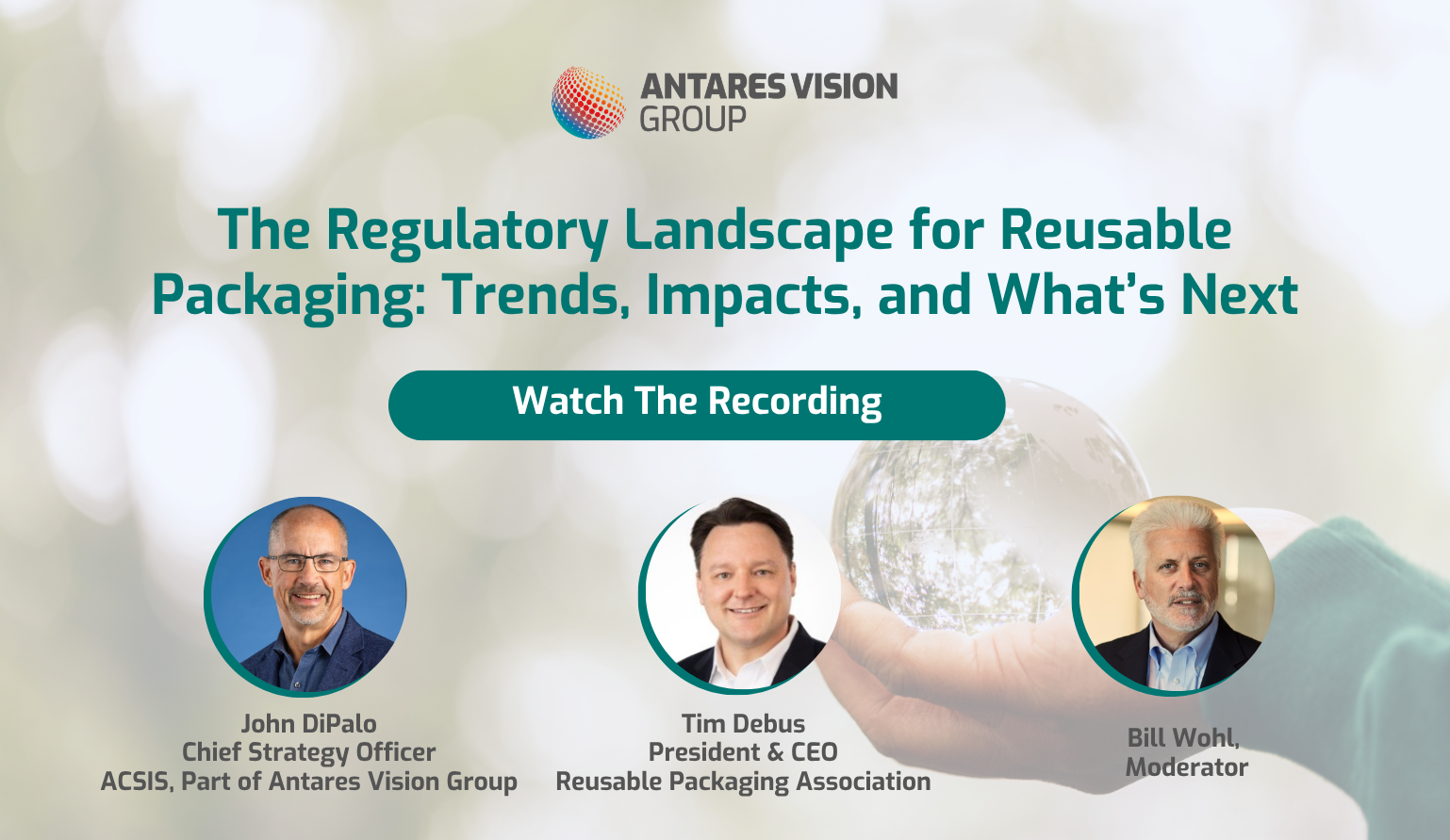
A LinkedIn Live Recap Featuring John DiPalo at ACSIS and Tim Debus at the Reusable Packaging Association.
Hosted by Bill Wohl on May 06, 2026
Watch the Full LinkedIn Live Recording
If you missed our recent live session on LinkedIn, no worries. You can catch the full replay right here:
🎧 Listen to the full LinkedIn Live replay here
📄 View transcript included below
Key Takeaways from the Discussion
Supply chain visibility has reached a tipping point. With advances in overhead antenna technology, passive RFID is no longer just about compliance — it’s about transforming warehouse operations. In this session, ACSIS Chief Strategy Officer John DiPaolo and RF Controls Co-founder Todd Spence explained how steerable phased array antennas are changing the game for real-time location systems.
Here’s what we learned:
Packaging Waste Has Reached Crisis Levels
Global solid waste generation is projected to increase by 50% over the next 25 years. Packaging represents about 28% of total municipal solid waste in the United States, and globally, only 9% of plastics are recycled. Landfills are filling up, pollution is increasing, and policymakers are responding with comprehensive packaging regulations.
Seven U.S. States Have Already Enacted EPR Laws
Extended Producer Responsibility (EPR) programs for packaging are now law in seven U.S. states, with each state taking different approaches. These laws shift financial responsibility for packaging waste from taxpayers and municipalities to the producers who introduce packaging into the market, creating economic incentives for sustainable practices.
The Patchwork Problem Creates Compliance Challenges
All seven state EPR programs have different definitions, requirements, and approaches. What complies in California may not comply in Colorado or Maine. Interstate commerce becomes complicated, and companies face the challenge of navigating multiple regulatory frameworks simultaneously without a unified federal standard.
Reusable Packaging Gets Regulatory Incentives
Many EPR laws are designed to incentivize source reduction and reuse systems. In California, for example, reuse and refill systems are exempt from covered material requirements. This creates opportunities for companies already using or considering returnable packaging systems.
Trillions in Material Value Are Being Lost
Products ending up in landfills or escaping into the environment still have economic value. Fiber can become new cardboard boxes. Plastics can become new resin and products. The circular economy conversation centers on decoupling economic growth from resource consumption, and reusable packaging plays directly into that vision.
Returnables Create Supply Chain Intelligence
Returnable packaging becomes a proxy for what’s inside it. As packaging returns through the system, companies gain visibility into the full lifecycle from shipment to consumption. This creates planning signals and forecasting signals that never existed with single-use packaging, enabling companies to tighten their supply chains significantly.
Flexibility Is Critical for Technology Systems
With seven states today and potentially many more coming, companies need flexible tracking and documentation systems capable of adapting to changing requirements. This isn’t just about scanning a box — it’s about documenting contents, returns, reuse cycles, and proving compliance to avoid taxes, penalties, or fees.
E-Commerce Will Eventually Embrace Reuse
While further out on the horizon, consumer satisfaction, economics, and technology integration will eventually drive reusable packaging adoption in e-commerce. Automation and robotics already demand more durable packaging, and once you’re designing for durability, the next logical question becomes: why not reuse it repeatedly?
🎙️ LinkedIn Live Transcript: Regulatory Landscape for Reusable Packaging
Below is the full transcript from the LinkedIn Live session, lightly edited for clarity and formatting.
Bill Wohl: Hello and welcome to today’s LinkedIn Live program as we explore supply chain best practices brought to you by my friends at the Antares Vision Group, real experts in supply chain and technology.
Today, we’re going to explore the public policy side of the supply chain, part of our continuing series on supply chain visibility stories.
I’m your host, Bill Wohl, and I’ve worked in the enterprise software and data space for more than 20 years, and I’m always fascinated by the intersection of business and technology. No matter what industry you work in, supply chain management is critical, and I’ve been fortunate to cover the latest in technology deployed to address these critical issues out at the edge and into core ERP solutions.
It continues to amaze me how best practices in supply chain can be addressed across industries.
Today’s conversation is also an interactive one, and I encourage you in the audience to participate. Use today’s webinar platform to give us your name, title, and where you’re located so we get a sense of who’s joining us today. Use that same comments area to post any questions you’d like to ask throughout the program, and we’ll try to address them during the course of our time together.
My most productive conversations on supply chain have been with my friends at ACSIS, now part of the Antares Vision Group. So it’s my pleasure to welcome a regular guest of mine, Chief Strategy Officer John DiPalo, to the program. John, so good to talk to you again.
John DiPalo: Bill, how are you doing? Good to be here.
Bill Wohl: It’s good to be here, too.
I’m also excited to welcome back to the program a returning guest, Tim Debus, President and CEO of the Reusable Packaging Association. Tim, good to have you with us again.
Tim Debus: Yeah, thanks Bill. It’s great to be back here.
Bill Wohl: It was great to see you and John at Pack Expo recently in Philadelphia and share some conversations together.
For some of the audience who might not know the RPA, tell us a little bit about the organization and its purpose.
Tim Debus: Thanks.
The Reusable Packaging Association is a nonprofit trade organization that seeks to raise awareness through education and advocacy about the value of reusable transport packaging in supply chains.
We’re focused on developing systems in which products like pallets, bulk bins, containers, and trays are used continuously in managed systems where they’re always diverted from the waste stream and put back into place where they can optimize their benefits and contributions to distributing goods.
Our organization is made up of member companies that participate in some way in reuse systems within the supply chain. We’ve been around for over 25 years now, so reuse is not a new concept or phenomenon in terms of our business interests.
What we do is tap into that expertise developed over decades to provide real-world experiences through education and information so the marketplace and stakeholders can feel confident about how reuse systems can be deployed within their own operations.
Bill Wohl: John and I have had opportunities on a number of programs to talk about a variety of reusable packaging systems. Some are relatively common and typical, like totes used to ship auto parts or food products back and forth. We’ve also discussed more complex products like large cable reels and specialty packaging for industrial glass.
It’s a fascinating topic.
We’ve never really talked about the public policy side of things, but I know a lot of what is driving customers today to look at reusable packaging is the potential for new regulation. Some already exists, and more are likely on the legislative agenda.
From your perspective, Tim, what’s on your radar screen right now that should be front and center for companies to consider?
Tim Debus: Certainly, public policy, legislation, and regulatory schemes impacting packaging are at the top of everybody’s mind.
There’s a reason there hasn’t been much dialogue over the years. It’s relatively new for packaging. Historically, rules focused on food packaging, medical distribution, pharmaceutical distribution, or labeling requirements.
What we’ve seen over the last few years is rapidly moving legislative initiatives intended to impact the entire packaging industry. For the first time, all packaging is front and center in terms of how legislation is being developed to mitigate packaging waste and pollution.
That’s the new environment we’re in now.
Policy around the world is rapidly changing and impacting packaging. One reason is that solid waste generation continues to increase. We’re massive consumers generating large amounts of trash, and it’s becoming more difficult to manage.
The projection is that global solid waste generation will increase by 50% over the next 25 years. Landfills are filling up, and per-capita waste generation continues to rise.
The second issue is pollution resulting from packaging that leaves the system and isn’t properly managed. Plastics are a major concern. Packaging represents about 28% of total municipal solid waste generation in the United States.
Globally, only about 9% of plastics are recycled. Those numbers point to an alarming situation.
Policy responses, whether in Europe with the Packaging and Packaging Waste Regulation or in the United States through Extended Producer Responsibility programs, are gaining traction to address this.
There’s another important point, which is the loss of material value. Products ending up in landfills or escaping into the environment still have economic value. Fiber can become new cardboard boxes. Plastics can become new resin and products.
There are trillions of dollars of lost value globally. That’s part of the circular economy conversation: achieving economic growth decoupled from resource consumption.
Reusable packaging plays directly into that.
Bill Wohl: John, in our discussions on supply chain over the last couple of years, one thing has remained constant: technology is always shifting.
We’ve also discussed how supply chain technology is impacted by regulation and mandates. Sometimes those mandates come from government. Sometimes they come from major retailers like Walmart.
For supply chain technologists, should these topics be viewed primarily as compliance and cost avoidance issues, or should companies also be looking at ROI from technology investments tied to these regulations?
John DiPalo: I agree with that framing.
Oftentimes, depending on who you’re talking to, the business benefit side gets overlooked.
As regulations expand, the idea of “think globally, act locally” becomes important because different geographies adopt different rules. That could mean different countries, different states, or even municipalities.
If you don’t approach this holistically from a business benefit perspective, you wind up with a patchwork quilt approach, solving individual issues in isolated locations. That ends up costing money instead of creating value.
The better approach is to ask: how can I fulfill the regulation while also getting operational benefit?
There is real benefit in using returnable packaging systems in the supply chain. Yes, there’s an upfront investment and process change involved, but once implemented, those benefits continue indefinitely.
Bill Wohl: I want to come back to that patchwork topic with Tim in a moment, but I also want to expand on something you said.
This isn’t simply about cost avoidance. You’re not just avoiding disposal costs or fines associated with regulation. Once you implement reusable packaging, the data captured in that process gives you far greater real-time visibility into the supply chain.
John DiPalo: Correct.
The way I think about it is that returnable packaging becomes a proxy for what’s inside it.
In the past, if I shipped product in corrugate, I had no visibility into when that product was consumed. Once shipped, the packaging was discarded, and the process disappeared from view.
In a returnable environment, as packaging comes back, I can start understanding the full lifecycle from shipment to consumption. That creates intelligence around the supply chain.
We can’t let a discussion go by without mentioning AI and large data sets. Once you start capturing that information, you can tighten your supply chain significantly.
The returnables become planning signals and forecasting signals that never existed before.
You can certainly implement returnables without tracking them, but then you lose the visibility benefits associated with round-trip tracking and the associated metadata: what’s inside, where it went, how long it stayed there, and so on.
Bill Wohl: Tim, John used the word “patchwork,” which leads directly into my next question.
Most companies listening to this program don’t operate in a single state. In the United States alone there are 50 states with regulatory potential, plus federal regulations. Most supply chains are global in some aspect.
So this creates a patchwork scenario.
I know some states have already started down this regulatory path. How are you seeing this from the association perspective? Are you working toward common standards across states?
Tim Debus: Very big topic.
The word “patchwork” is very popular right now for exactly those reasons.
Seven U.S. states now have Extended Producer Responsibility laws in place for packaging, and they’re all moving at different speeds while developing regulations and implementation programs.
All seven are different. They have different definitions, different requirements, and different approaches.
That’s where industry struggles. Interstate commerce becomes complicated because compliance in one state may fail in another.
For reusable packaging specifically, many EPR laws are designed to incentivize source reduction and reuse systems, which is positive for our industry.
For example, in California, reuse and refill systems are exempt from covered material requirements under the law. That’s not true in every other state.
So the question becomes: how do producers comply consistently?
That story is still being written. There will be legal challenges, trial and error, and continued refinement.
There is recognition in Washington D.C. that perhaps a national EPR framework for packaging may eventually be needed to create consistency across all 50 states, but we’re nowhere close to that yet.
For now, the industry is focused on understanding the seven existing state programs and how they impact recycled content, recycling rates, and conversion to reuse systems.
Bill Wohl: We certainly see examples where governments or large economies become de facto standards setters. California has often played that role on environmental issues.
Do you think one leading state eventually establishes the model everyone else follows, or is this going to remain fragmented for quite some time?
Tim Debus: I do think there will be front-runners.
With each new EPR law, states have borrowed certain concepts and best practices from prior legislation. In theory, newer laws should incorporate better thinking.
At the same time, every state customizes legislation around its own political environment, stakeholders, and lobbying pressures.
Ultimately, economics will drive much of this.
Remember, the purpose of EPR is to shift financial responsibility for packaging waste from taxpayers and municipalities to producers who introduce the packaging into the market.
That economic shift is designed to create incentives for more sustainable approaches: higher recycled content, alternative materials, and reuse systems.
States also see this as a potential revenue stream to fund waste management and environmental programs.
So economics will heavily influence which programs emerge as models for others.
Bill Wohl: Speaking of economics, John, when we start thinking about the technology side of this, we’ve discussed everything from basic barcoding to RFID and more advanced tracking technologies.
For circular systems designed to capture data and satisfy reporting requirements, it seems like RFID eventually becomes the preferred technology.
John DiPalo: I think that’s a fair statement.
Today, we look at barcode, RFID, vision systems, GPS, Bluetooth Low Energy, and a variety of identification technologies. All of them have roles to play.
The key issue is flexibility.
We have seven states today and potentially many more coming. Companies need flexible systems capable of adapting to changing requirements without requiring major redesigns every time a new regulation appears.
Hopefully, we avoid ending up with 50 different standards.
A good analogy is DSCSA in pharmaceuticals. Florida had e-pedigree requirements, California had serialization requirements, and before we ended up with dozens of conflicting standards, federal guidance emerged.
Hopefully, packaging regulation follows a similar path.
But regardless, flexibility in data capture, reporting, and technology integration will be critical.
Bill Wohl: And flexibility matters because this is still an emerging regulatory area.
Companies need tracking and documentation systems capable of adapting as requirements evolve internationally and across jurisdictions.
This isn’t just about scanning a box. It’s about documenting contents, returns, reuse cycles, and proving compliance to avoid taxes, penalties, or fees.
That creates both operational complexity and opportunity.
John DiPalo: Correct.
You could certainly implement a standalone tracking system, but siloed systems always struggle because they lack integration with ERP and master data systems.
The real key is integrating your business systems, ERP systems, and regulatory reporting systems so they all work together.
Bill Wohl: We’ve seen explosive growth in e-commerce. Everybody sees Amazon boxes everywhere.
Do you expect reusable packaging to become part of e-commerce, or is reuse primarily an industrial supply chain solution?
Tim Debus: I do think reuse eventually becomes part of e-commerce, although it’s probably further out on the horizon.
EPR fees will impact e-commerce packaging because corrugated boxes are considered covered materials in many programs, though they often receive lower fee structures because of higher recycling rates.
In Europe, under PPWR rules, corrugated boxes may even be exempt from certain targets. Again, that demonstrates the complexity and variation between programs.
In e-commerce specifically, I think consumer satisfaction, economics, and technology integration will drive adoption.
Consumers will need greater awareness and acceptance of reuse systems, but I think that can happen through education.
Operationally, we already have trucks moving in and out of neighborhoods constantly. Those vehicles could also support collection and return systems.
We’re also seeing automation drive demand for more durable packaging. Robotics require precision and durability. Once you’re designing durable packaging, the next logical question becomes: why not reuse it repeatedly?
I think e-commerce eventually realizes that reuse is simply a smarter and more cost-effective approach.
Bill Wohl: The reality is that enormous industrial supply chains feed e-commerce distribution centers anyway, and that’s where many of your member companies operate.
Tim, one final question.
This conversation really highlights why trade associations matter. No individual manufacturer or shipper wants to deal independently with regulations across 50 states.
This seems like a strong argument for companies to participate in organizations like yours.
Tim Debus: Absolutely.
We’re structured to engage member companies in conversations, forums, and collaboration around emerging policy developments.
We provide intelligence, insights, and opportunities to collaborate on position papers, case studies, and educational efforts that help inform the market.
We also advocate directly with policymakers.
One thing we’ve learned through all of this is that many policymakers simply do not understand reuse systems. They don’t understand the complexity or scale of reuse already operating behind the scenes in supply chains.
People often talk about reuse as if it’s an entirely new concept. Meanwhile, reusable pallets already move roughly 90% of goods in the United States.
Our role is to draw on real-world operational expertise to educate policymakers and help shape effective policy while also promoting our member companies and their stories.
Bill Wohl: That’s why we enjoy having you on the program.
Tim Debus, President and CEO of the Reusable Packaging Association, thanks for joining us.
John, before we go, we always like ending with a practical question: how do companies get started?
My takeaway from today’s discussion is that flexibility is critical because the regulatory environment is still evolving.
John DiPalo: Flexibility is key.
Start by identifying a class of product that you’re already shipping in returnables or could move into returnables. Pilot a solution, gain experience, and build from there.
As always in supply chain, success comes from having the right partners at the table.
Bill Wohl: John DiPalo, Chief Strategy Officer at ACSIS, as always, thanks for being a great guest.
Tim, thanks again for joining us.
This entire series of supply chain discussions is available online. You can view previous podcasts and LinkedIn sessions and share them with colleagues.
If you’d like more information about the Reusable Packaging Association, visit their website at reusablepackaging.org.
Tim is also active on LinkedIn.
For more information about supply chain solutions from ACSIS, visit their website at acsisinc.com.
My thanks to the team at Antares Vision Group for bringing us today’s program.
For Tim Debus and John DiPalo, I’m your host, Bill Wohl.
Please join the conversation online, share the recording once it’s posted, and until next time, good day. Bye-bye.